

COMMON LAMP WIRE QUESTIONS
What is the Shortest a Lamp Cord Can Be?
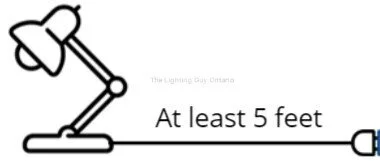
The Shortest a Table or Floor Lamp Cord May Be is Five Feet ( 1.5 Meters ) Long Externally From the Edge of the Base to the End of the Plug. (Any Length of Wire Used Internally Must Be Added to the Five Foot External Length Of the Cord). This is to Discourage the Use of Extension Cords.
We recommend 8 Foot Cords to Wire Table Lamps and 10 Ft or Longer for Floor Lamps.
The Shortest a Swag Lamp Cord Can Be is 15 Feet Long and when Routed Through the Chain Must Extend at Least One Foot Beyond the End of the Chain.
Type of Wire to be Used is determined by the application.
Portable Table Lamps:
Exterior from Base of Lamp to Plug - Use SVT or SPT-2 or Equivalent Type Wire.
Note: Many Older Table Lamps use SPT-1 on the Exterior.
Internal Connection Wiring - Use SPT (1 or 2) or AWM 105 Deg. or TFFN or PTFE
Wire Pendant Hanging Lamps:
Fixtures 5 lbs or less - Use SVT Type Wire with proper Strain Relief Bushing.
Fixtures 10 lbs or less - Use SJT Type Wire with proper Strain Relief Bushing.
Chain Hanging Fixtures:
Exterior Threaded through the Chain - Use SPT-1 Type Wire
All Internal Fixture Wire:
Internal Connection Wiring - Use SPT (1 or 2) or AWM 105 Deg. or TFFN or PTFE
Please Note:
22/2 PLT is We recommend it for very limited use in rewiring antique lighting fixtures when you have no other choice. Never use more than 60 watts at 120 Volts.
20/2 PLT is We recommend it for very limited use in rewiring antique lighting fixtures when you have no other choice. Never use more than 75 watts at 120 Volts.
Commonly Recommended Lamp Wire Capacities:
Nominal 120 Volts AC - 50 ft or Less:
18 AWG- 10 Amps - 1200 Watts
16 AWG - 13 Amps - 1560 Watts
14 AWG - 15 Amps - 1800 Watts
Please Note:
22/2 PLT We recommend it for very limited use in rewiring antique lighting fixtures when you have no other choice. Never use more than 60 watts at 120 Volts.
20/2 We recommend it for very limited use in rewiring antique lighting fixtures when you have no other choice. Never use more than 75 watts at 120 Volts.
American Wire Gauge (AWG), i a standardized system used since 1857 predominantly in North America for the diameters of round wire. Increasing gauge numbers equals decreasing wire diameters. (22 gauge is thinner then 18 gauge). The larger the Diameter (Smaller Gauge Number) the more current handling capacity the wire will have.
The Pressure that Pushes Electricity Through the Wire is Called Voltage (E) Measured in Volts. The Amount of Electricity Flowing Through a Wire when Voltage is Applied is Called Current (I) and is measured in Amps . The Power Consumed by the Light Bulb is Called Wattage (P) measured in Watts.
Joule's Law States: P = I x E or Watts = Amps x Volts
A 100 Watt Bulb(P) at 120 Volts(E) uses .833333 Amps or
100 Watts = 120 Volts x .833333 Amps
or .833333 Amps = 100 Watts / 120 Volts
WHAT IS THE DIFFERENCE BETWEEN SPT-1 AND SPT-2 WIRE?
The difference between SPT-1 and SPT-2 wire is the thickness of the insulation surrounding the copper wire. SPT-1 wire has a thinner insulation than SPT-2.
18/2, SPT-1 wire has an insulation thickness of .030″ and 18/2, SPT-2 has insulation that is .045″ thick.
UL recommends using SPT-2 when building table lamps. However, because the thickness of the insulation is thicker it is more difficult to to use with our 1/8ips nipples and pipe. It does fit but the fit is tight.
WHEN SHOULD I USE A GROUND WIRE?
Grounding is an Important Safety Concern.
Grounding the Metal on a Lighting Fixture Assures that If Any Electrical Component of a Light Fixture Should Fail the Potential for Electrocution Hazard is Minimized by Triggering the Circuit Fault Protector (House Circuit Breaker or Fuse).
Grounding Must Be a Continuous Connection through all Metal Parts.
Moving Connections are Not Considered a Good Ground (Such as Swivels, Hang Straights or Chain) and a Grounding Wire Should be Used to Join the Segregated Sections of the Fixture.
Crossbar Mounting Screws Should Not Be Considered a Ground. A Separate Grounding Lead Should be Used.
Wire Cord Pendants Must have a ground if the pendant has any metal parts which can become energized from a damaged wire.
WHAT IS SVT TYPE WIRE ?
SVT is a Round Standard Use Service Cord. It can be used in Portable Lamps, Pendant Lighting, Floor Lamps, and House Hold Appliances such as Clocks, Fans or Entertainment Equipment. (Cord Rating Must Match Load of Appliance) The Interior has Separate Color Coded PVC insulated stranded copper conductors. The Core may contain Poly Rope type filler to add elongational strength to the cord. The Outer Wrapping is PVC. History: The name SVT came from its original use SVT = Service Cord Type Vacuum Cleaner Thermoplastic.
Common Rating for Lighting: 300 Volts 105°C
Conductors: 18/2 - 18/3
UL Spec No. 62
CSA Spec. C22.2